In this post, Simon Schüz discusses the article he recently published in Ergo. The full-length version of Simon’s article can be found here.

Today, “transcendental arguments” are usually viewed with the same nostalgia and estrangement with which we encounter ancient temples from distant times and cultures. We respect their grand design and metaphysical ambition, yet we tend to view them as relics of a superseded era.
Since Immanuel Kant, transcendental arguments have promised to reveal how the world must be in order for thought/experience to be possible. From Kant’s proof that inner experience presupposes outer experience of an external world to Fichte’s claim that self-awareness requires the existence of other persons, the ambitious goal has always been “world-directed”—moving from the certainty of our inner mental states to the necessity of an outer reality.
The 20th century brought a wave of sobering critiques. Logical Empiricism’s rejection of the synthetic a priori and W.V.O. Quine’s attack on the analytic/synthetic distinction gave way to the conviction that we cannot simply reason our way into the structure of the world.
The final blow came from Barry Stroud’s (1968) substitution objection: given any purported ‘outer’ transcendental condition of something ‘inner’ like thought or experience, what bars us from substituting it with the mere belief in something outer? Stroud argued that transcendental arguments only reveal how we must think or believe the world to be. We might be conceptually locked into believing in an external world, but that necessity remains internal to our minds. From the necessity of a belief, it does not follow that the belief is true.
In my paper, I argue that this skeptical trap is actually a two-way street. The very confidence with which the Stroudian skeptic levels their objection is also their Achilles’ heel.
For their confidence to be warranted, the Stroudian actually needs the support of a transcendental argument themselves. To maintain that our beliefs might fail to match reality, the skeptic must presuppose a certain yardstick of objectivity enforcing a principled gap between, on the one hand, holding a belief and, on the other hand, the truth of that belief.
This leads to a dialectical dilemma. If the skeptic’s yardstick is just another fallible belief about the world, their objection loses its authority – it even becomes incoherent. But if they claim this yardstick is a necessary condition for the very possibility of their doubt, they must confer a special, indubitable status on it: the status of what I call transcendental beliefs.
To see this, consider Ludwig Wittgenstein’s analogy to the standard meter in Paris. For decades, a physical bar defined the length of a meter. To ask if the bar itself was “one meter long” was a category mistake. The bar was not one meter long because it matched an external standard; it was the standard.
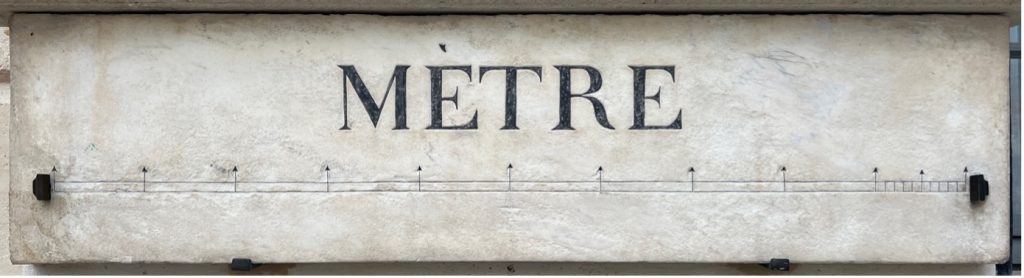
Transcendental beliefs work the same way. They aren’t just hunches about the world that might be wrong. While the skeptic can assert that we can be wrong about empirical facts (like whether it’s raining), it is impossible for us to be mistaken about the transcendental propositions that make the idea of ‘objective facts’ possible in the first place.
Thus, transcendental arguments do not have to problematically move from something ‘inner’, like experience, to the ‘outer’ world. Rather, they show which beliefs are indispensable for our very notion of an objective world.
Want more?
Read the full article at https://journals.publishing.umich.edu/ergo/article/id/4652/.
About the author
Simon Schüz is Assistant Professor at the RPTU University Kaiserslautern-Landau, Germany. He works on philosophical anthropology, transcendental philosophy, and the history of German idealism. He is the author of Transzendentale Argumente bei Hegel und Fichte (De Gruyter, 2022).